

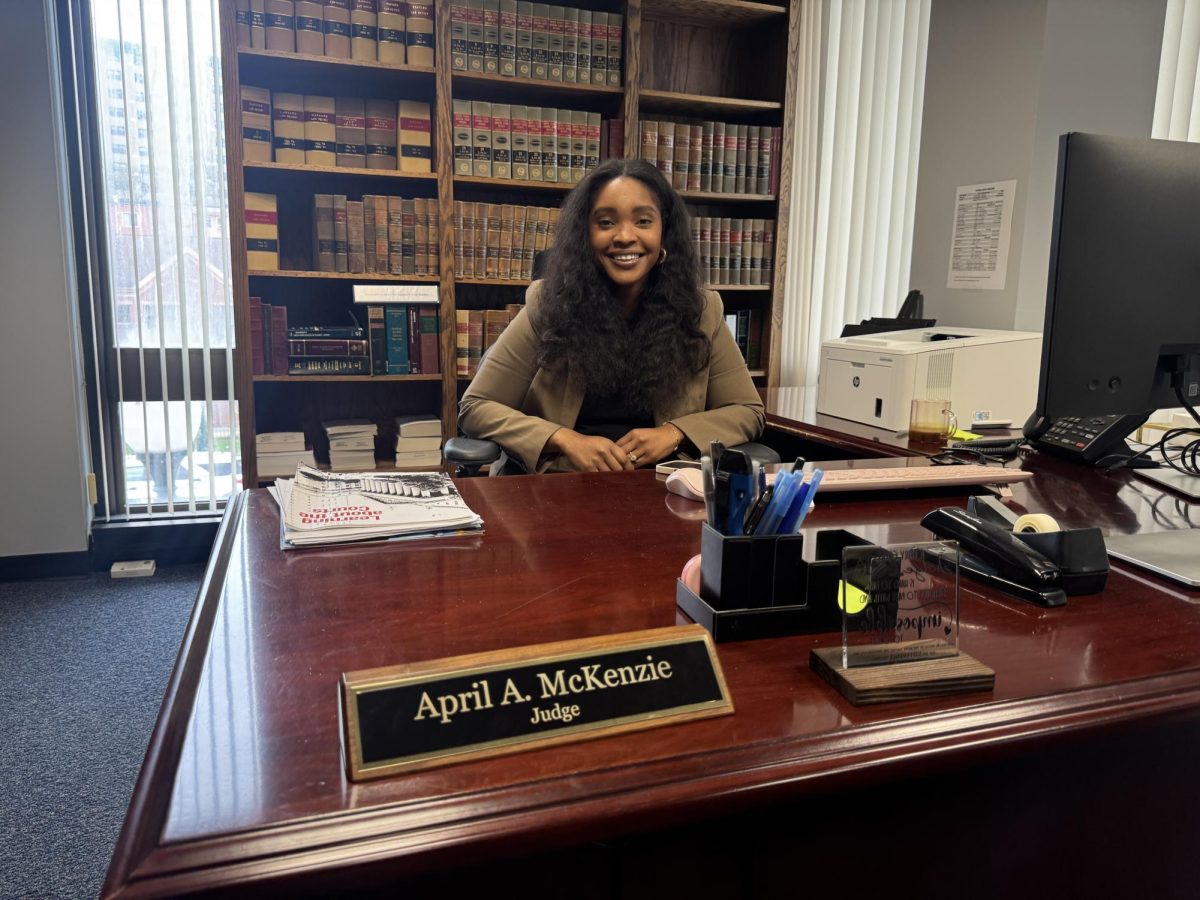


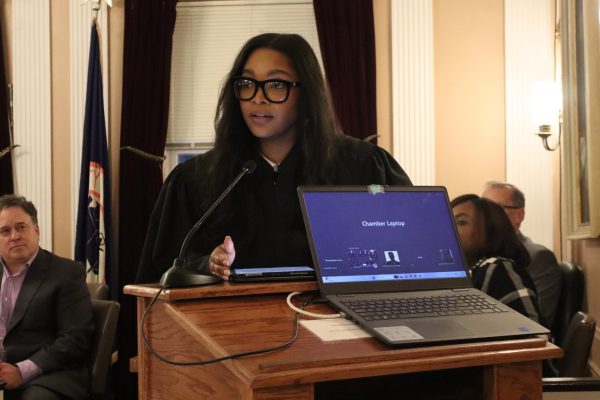
When April Mckenzie (no relation to Peekskill Mayor Vivian McKenzie) stood before the Peekskill Common Council on March 24 to be sworn in as new part-time assistant city court judge, the moment represented far more than a professional achievement.
Just before she slipped on her judicial robes for the first time, her mother jumped up in celebration. Family members, friends, sorority sisters, judicial colleagues and supporters filled the room with applause.
For Mckenzie, the appointment marked the culmination of a journey that began decades earlier in the Bronx, where a talkative young girl with a love of books, history and debate slowly discovered a calling in law.
“Being appointed as part-time city court judge for the City of Peekskill is not just a professional milestone, but it is a profound responsibility that I accept with both humility and resolve,” Mckenzie said during her swearing-in ceremony. Her term began March 26, 2026, and runs through Dec. 31, 2031.
Today, she presides over criminal, civil, landlord-tenant, traffic and code violation cases in the same courthouse where she once appeared as a young public defender and later worked as a court attorney. But McKenzie says becoming a judge was never something she imagined for herself as a child.
“If you told eight-year-old April that she’d be a judge one day, she would laugh and say no,” she said.
A childhood shaped by education and tenacity
Mckenzie grew up in the Wakefield section of the Bronx as the youngest of six children in a Jamaican-American family. She describes herself as a first-generation American whose parents emphasized hard work, education and perseverance.
Her father, a Con Edison employee who never attended college, developed a creative system to motivate his children academically. Report card grades translated into spending money at Toys“R”Us. An A earned $20. A B earned $10. A C earned $5.
“He was like, this is how life works,” Mckenzie recalled. “If you work hard, you earn better opportunities.”
Her mother, who raised six children while working multiple jobs, became another source of inspiration. After raising her family, she returned to school and earned her certification as a licensed practical nurse.
“I remember being so proud,” Mckenzie said. “This woman who was working two jobs to support us was still going back to get her education and move forward.”
Mckenzie earned a scholarship to attend Aquinas High School in the Bronx, where a history teacher helped shape her future. Originally torn between becoming a museum curator or a lawyer, she found herself drawn to both history and legal studies.
“He told me the most important thing was to study something you’re passionate about,” she said. “The law can intersect with so many different fields.”
Discovering the power of advocacy
Long before law school, Mckenzie had already developed a personal understanding of how lawyers can impact lives.
Growing up, she watched attorneys represent family members and neighbors navigating legal troubles. One experience in particular left a lasting impression.
Her brother was represented by an attorney who, Mckenzie said, fought relentlessly on his behalf.
“The way that she advocated for my brother made me see her in a new light,” Mckenzie said. “She made us feel like there was someone who believed in him and therefore believed in us.”
The experience stayed with her. She knew then — “that was the kind of lawyer I would want to be if I became a lawyer.”
During high school, she participated in the Bronx District Attorney’s Office Youth Trial Advocacy Program. There, a mentor taught her a lesson she still carries today. “The five Ps: Prior preparation prevents poor performance.”
The phrase became a guiding principle throughout her education and legal career.
Building a legal career
Mckenzie attended Pace Law School after earning dual bachelor’s degrees in history and legal studies from Quinnipiac University in 2014.
There, she became involved in the Black Law Students Association, found mentors who remain close friends, and gravitated toward criminal defense work through internships and clinical experiences.
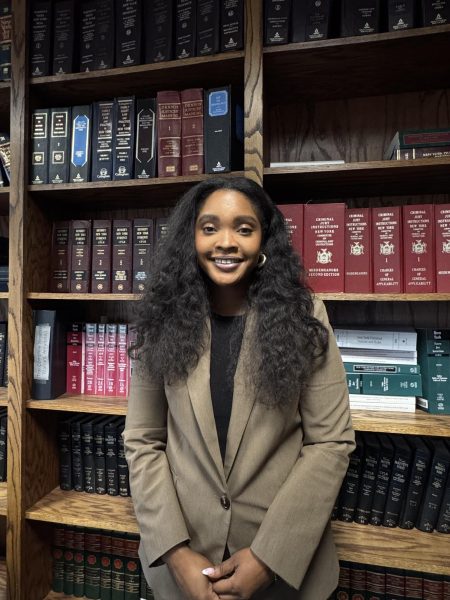
By her final year, she qualified as a Pro Bono Scholar, allowing her to take the New York Bar Exam before graduating in 2017.
After law school, Mckenzie joined the Legal Aid Society of Westchester, where she would spend the next eight and a half years.
Starting as a criminal defense attorney, she handled everything from misdemeanors to homicide cases, eventually rising to senior counsel and region chief. Her first misdemeanor trial happened in Peekskill.
At Legal Aid, she represented clients who could not afford private attorneys. She says she often met people during the worst moments of their lives.
“They felt like the world was against them,” Mckenzie said. “I enjoyed being the person who could say, ‘Hey, I got you. We’re going to figure this out.’”
The work changed her perspective on justice. “I learned the human side of law,” she said.
Representing people facing criminal charges taught her to look beyond case captions and criminal allegations. “This isn’t just John Doe versus Jane Smith,” she said. “These are real people with families, histories and life experiences.”
That perspective remains central to how she approaches her new role on the bench. “I don’t think it makes me soft or biased,” she said of her defense background. “I think it makes me thorough.”
Falling in love with Peekskill
Although she grew up in the Bronx and later lived in Yorktown, Mckenzie says her connection to Peekskill developed gradually.
When she joined Legal Aid, she was assigned to the Peekskill region. Alongside her supervisor, Mckenzie frequently visited local coffee shops and restaurants between court appearances.
Soon, Mckenzie found herself spending most of her days in the city, even making the Peekskill Coffee House her unofficial office. “I started to fall in love with this place,” she said.
Even after later assignments moved her to Mount Vernon and White Plains, she kept returning to Peekskill whenever she could.
When the position of associate court attorney became available in 2024, colleagues encouraged her to apply. The job brought her back to the city she had grown to love.
Less than a year later, she and her fiancé moved to Peekskill permanently. “We’re really happy here,” she said.
From court attorney to judge
Mckenzie spent nearly a year as associate court attorney in Peekskill City Court, working alongside Judges Sophia Trott and Lissette Fernandez.
The position immersed her in legal research, judicial decision-making and court administration. She drafted legal memoranda, analyzed emerging case law, conducted conferences and helped judges navigate complex legal issues.
The experience, she says, prepared her well for judicial service. “I learned a lot about what it takes to run a court,” she said. “I learned a lot about the difficult decisions judges have to make day in and day out.”
Today, she serves primarily on Thursdays, Fridays and one Wednesday each month, hearing dozens of cases daily.
On some Fridays, she handles approximately 100 traffic matters in addition to landlord-tenant cases. Criminal calendars can include as many as 60 to 70 matters.
Her goal, she says, is simple. “We’re trying to make sure everybody gets their day in court as soon as possible.”
Respect, dignity and opportunity
During her swearing-in ceremony, Mckenzie pledged to treat every person entering her courtroom with respect and dignity.
Those words were not simply a part of the ceremony. They reflect a philosophy shaped by years spent representing clients, listening to victims and witnessing the consequences of legal decisions.
“I think part of that is really taking time to listen to both sides,” she said.
That means ensuring people understand court procedures, have access to interpreters and legal resources, and feel heard regardless of the outcome.
“No one wants to be in court,” she said. “People come in upset. They come in stressed…. Sometimes they just need to be heard.”
Looking ahead, Mckenzie hopes to leave a lasting impact on both the court system and the community.
One of her major goals is developing programming for emerging adults — young people roughly between the ages of 17 and 25 who are navigating adulthood while still developing emotionally and neurologically.
She points to programs in New Rochelle and Mount Vernon that connect young offenders with services and support aimed at reducing future involvement in the justice system.
“I would love to see something like that here in Peekskill,” she said.
Most of all, she hopes her story serves as an example for young people who may not see themselves reflected in positions of leadership. “I hope to inspire,” she said. “I hope to encourage the younger generation. I hope to make a positive impact on the community.”
For the young girl from the Bronx who once dreamed of museums, history and helping people, the path ultimately led to a courtroom in Peekskill.
And as she continues her first year on the bench, Mckenzie says she remains guided by the same principle that has shaped her journey from the beginning: Prior preparation prevents poor performance.
[Editor’s Note > The above article was updated at 3:35 p.m. on Wednesday, June 3, to correct the spelling of April Mckenzie’s surname and to clarify that she is not related to Peekskill Mayor Vivian McKenzie.]