

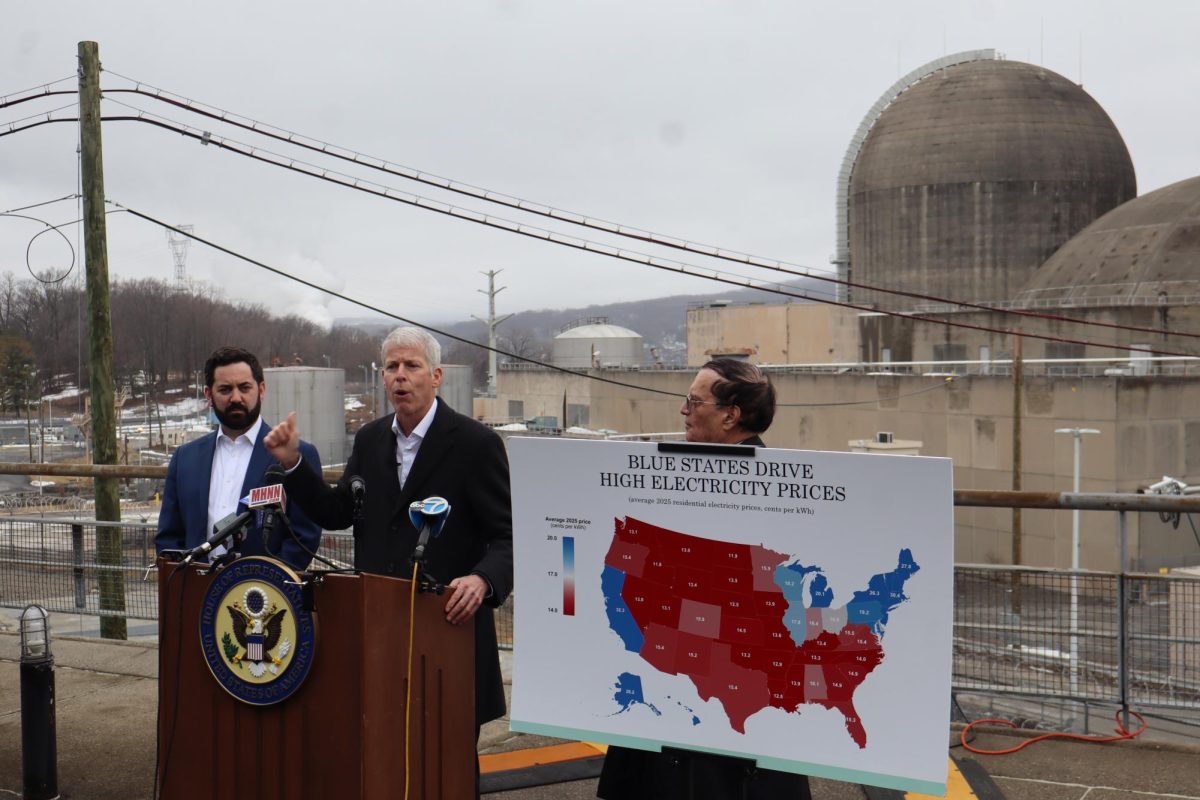

Calls to reopen the shuttered Indian Point nuclear power plant to combat high electricity prices were made by U.S. Energy Secretary Chris Wright and U.S. Rep. Mike Lawler (NY-17) at a press conference at the plant on Friday, March 6. A reboot would first have to overcome continued opposition from multiple governmental state and local entities.
“The reality is this facility right behind me can be rebuilt,” Wright said. “This facility could generate the power that is needed for New York. If you want [semiconductor company] Micron to come to New York, if you want data centers to be built here in New York, if you want semiconductors to be built, you need power.”
The plant, which supplied roughly a quarter of New York City and Westchester’s electricity, was permanently shut down in 2021 due to environmental and safety concerns. Its decommissioning remains in progress by Holtec International, with a target date of 2041 for completion.

“Indian Point is an acute reminder of one of the most disastrous energy policy decisions Albany Democrats have made in decades,” Lawler said. “For more than 40 years, Indian Point delivered clean, reliable, carbon free electricity to millions of people across downstate… When it was shut down, that power generation disappeared, but the demand was still there.”
He added, “New York’s average residential electricity price reached $27.39 per kilowatt hour, 59 percent higher than the national average. Electricity prices in New York rose 12 percent over the past year, increasing twice as fast the national average and four times faster than inflation.”
Lawler and Wright were joined by Holtec International chief executive officer, Kris Singh, who along with a spokesperson told the Peekskill Herald the company would be ready to reopen the plant if there is political will for it.
“People who make policy, they need to step up to the plate,” Singh said. “Say, ‘Yes, let’s go do it.’ The demand is here. I think the pathway that the Secretary described, that we sell some power to data centers with high prices and sell low prices in the grid, so you bring business and at the same time people in the state get lower prices [is] perfect. We just have to put it to use.”
“The logical thing is we stand ready,” added Holtec International spokesperson Patrick O’Brien. “Should the decisions be made that they’d like to see this restart, we will be ready to do so.”
What Would it Take to Reopen?
Energy Secretary Wright said a rebooted Indian Point plant could be running in five years with a price tag of a little over $10 billion. He said that is less than it would cost to build a new plant.
The Palisades Nuclear Power Plant in Michigan, which was shut down in 2022, is slated to become the first U.S. nuclear power plant to be restarted by Holtec in 2026. Holtec has said several times that the same is possible at Indian Point.
However, unlike Indian Point, the Michigan power plant did not already have its reactors dismantled. Holtec spokesperson O’Brien previously told the Herald Indian Point could reuse materials and other components, but would need to craft new reactor internals to use the current vessels.
“There’s some dismantling that’s happened but some of that actually would have been done anyway,” Wright said. “You’re going to put a new reactor vessel anyway because that’s right near the core [where nuclear fission occurs to release immense energy].”
Electeds Take Sides For and Against Indian Point Restart
The biggest hurdle to a restart remains political will.
The terms of the shutdown agreement requires that all governmental entities, state and local, must agree on whether to reopen the center. Those parties include the Village of Buchanan, the Town of Cortlandt, Westchester County, New York State and the Hendrick Hudson School District.
Following the announcement, Town of Cortlandt Supervisor Richard Becker, Assemblywoman Dana Levenberg, Westchester County Executive Ken Jenkins, and County Legislator Colin Smith issued statements voicing their skepticism or outright opposition to the proposal to reopen Indian Point.
“Apparently, Congressman Mike Lawler brought President Trump’s Energy Secretary to Indian Point today to unveil Republicans’ latest plan to make life more expensive and dangerous,” Levenberg said. “Nuclear is the most expensive form of energy kilowatt hour; reopening Indian Point at this point in time would not bring utility costs down.”
“Restarting the Indian Point nuclear power plant is not welcome in Westchester County,” Jenkins said. “New York State already has access to a range of low-cost, environmentally responsible energy alternatives, including solar, wind, geothermal and hydropower. We do not need – and we do not want – Indian Point back online. The health and safety of millions of residents in the Hudson Valley will always matter more than reopening a nuclear facility.
The notion of a reboot is not without its supporters however. Village of Buchanan Mayor Theresa Knickerbocker, who was at the press conference, told the Herald over the phone that the Village of Buchanan lost half of its revenue after the shutdown and she would like Gov. Kathy Hochul to keep an open mind about putting nuclear power back at Indian Point.
“Buchanan is on board to put nuclear power back over there” if it’s done safely, Knickerbocker said. “I’m okay with renewables but nuclear needs to be part of the energy mix. Nuclear is base power. It’s not reliant on the weather, doesn’t matter if it’s sunny. It doesn’t matter if it’s not windy. It’s not reliant on batteries. This is a form of energy that produces no matter what is happening.”
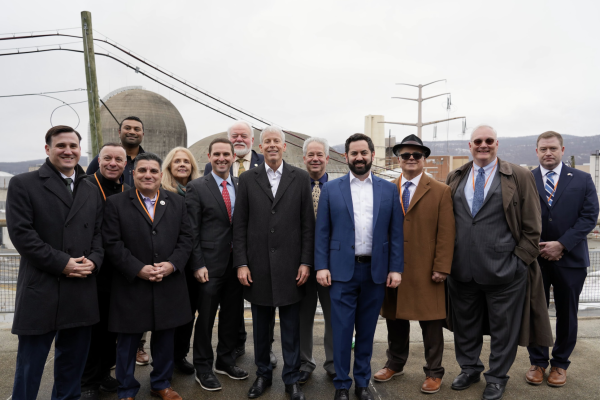
Other officials who were present at the reboot press conference included Hendrick Hudson School District Superintendent of Schools Michael Tromblee, Putnam County Executive Kevin Byrne, Putnam Legislator Bill Gouldman, Stephen Powers (from office of Rockland County Executive Ed Day), Attorney for Rockland County Thomas Humbach, New York Assemblymembers Anil Beephan, Karl Brabenec, and Matt Slater, Yorktown Supervisor Ed Lachterman and Yorktown Deputy Supervisor Sergio Esposito.
Pushback from Local Residents at Indian Point
Ahead of the March 6 press conference, about 15 community members and environmental advocates belonging to the Stop Holtec Coalition gathered at the east gate of Indian Point to voice opposition to nuclear power at the plant and to call for better decommissioning oversight.
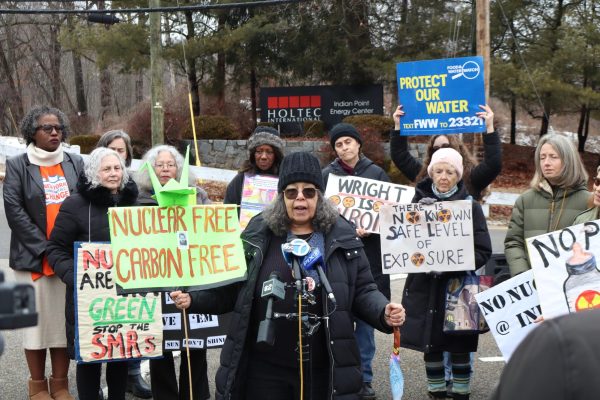
Rallygoers included Westchester and Rockland County residents, a parent of students in the Hendrick Hudson School District, and Rockland County Legislator Beth Davidson and Village of Tarrytown Trustee Effie Phillips-Staley, both Democrats seeking to unseat Lawler from Congressional District 17.
Pamela Hudson, a New City resident and anti-nuclear activist, said she attended the rally to represent her late uncle, Herbert Leroy Abrams, the head of radiology at Harvard University and an international expert on nuclear catastrophes. She said he also was part of an international conference on the Fukushima nuclear accident and a founding member of Physicians for Social Responsibility.
“Though he has passed away, it is my life’s mission to carry his message,” Hudson said. “What this sign here says: ‘There is no known safe level of exposure to ionizing radiation.’ We need to shut this down and we need to shut it down now.”
Following the press conference, in a phone call with the Herald, Tina Volz-Bongar, a co-organizer with United for Clean Energy/Stop Holtec Coalition, criticized the announcement.
“I think that it’s really geared toward Holtec’s IPO [Initial Public Offering] and I think it’s a way for them to raise money on Wall Street and I don’t think it’s based in reality,” she said. “I think that the site is way too polluted to conceivably rebuild. The waste and the pollution and everything needs to be remediated. And then it needs a complete re-license and then it’s going to take a lot of time and a lot of money before the energy would ever come online from this.”
Republicans introduced legislation in 2024 to reopen the defunct energy center. It would create a commission to reopen the center and conduct a feasibility study on nuclear modular reactors. The proposal remains in committee (under discussion) for the 2025/26 Senate session.
Last week, Lawler introduced legislation entitled the Economic Recovery for Nuclear Affected Communities Act. It is aimed at providing economic relief to communities that lost jobs and tax revenue after nuclear plant closures, but remain burdened by stranded nuclear waste and continue to store spent nuclear fuel onsite.