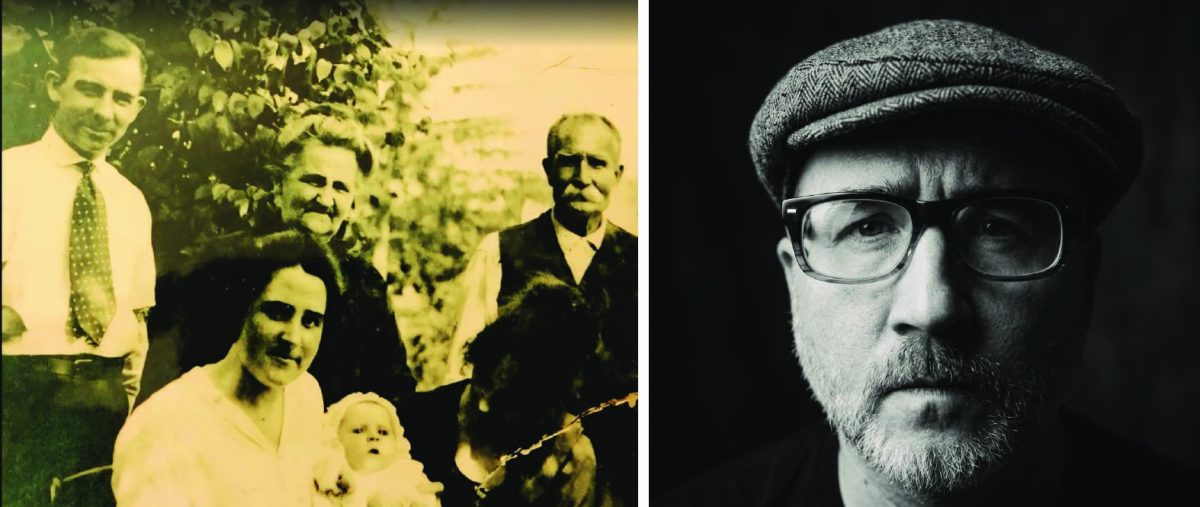


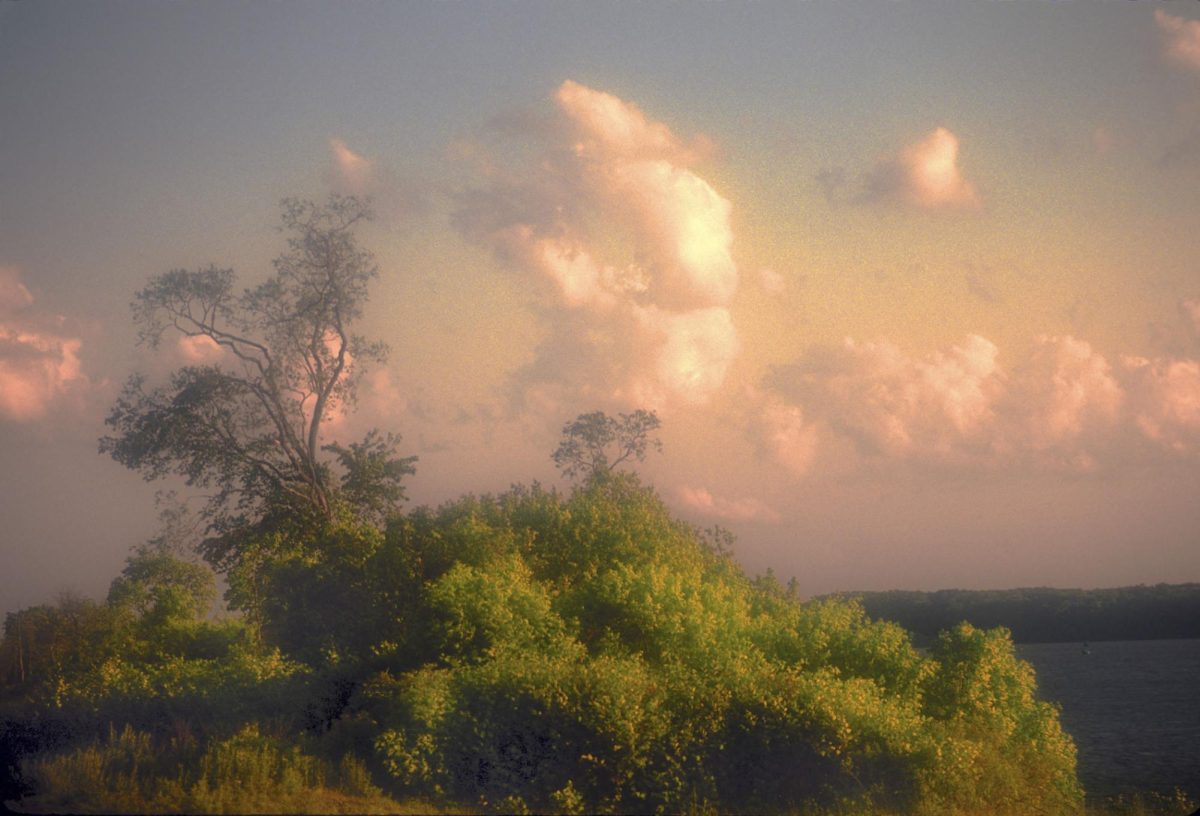

For a partial selection of Joe Squillante’s signature images, see the gallery below.
On March 13, Peekskill’s Joseph (“Joe”) Squillante will receive the prestigious ArtsWestchester 2026 Artist Award. The honor is the most recent of many accolades for the Peekskill artist, who is best known for the photographs he has taken of the Hudson River over the past fifty-plus years.
Squillante first picked up a camera as a child at his home in the Wakefield section of the Bronx. His father was an amateur photographer, and his child would sometimes remove one of his father’s Kodak cameras from the China closet. Squillante says he loved holding the “beautiful magic boxes” in his hands.
“What I found intriguing were the lenses and how the world looked when seen through them,” he remembers. “ I was also very interested in my magnifying glass. So I guess it was lenses, optics, and my eye seeing the world differently.”
Though Squillante never imagined he would become a professional photographer, he was enamored enough of cameras and photographs that he bought his first camera, a Honeywell Pentax, in 1972. Then he began developing photos and making prints in his own darkroom.
“I learned darkroom film processing and printing so that I could completely control the final outcome of how the photograph looks, how it is realized. It is about my interpretation of the captured moment of exposure and then that interpretation to the print,” Squillante says. “I still feel that photography is a work on paper, a gem to be held in one’s hands, just as is the camera.”
In the early years, Squillante photographed people on the streets of Manhattan, where he lived at the time. He captured still lifes. “And I always loved trees and nature,” he says.
-
Boy Fishing Tivoli © Joseph Squillante, 1976 In 1975 “the river came to me” when a boyhood friend from the Bronx bought a house right on the Hudson in Tivoli. I’d help him work on the house and in-between go to his backyard and make photographs. This signature, and iconic photograph was done in Tom’s backyard. I immediately recognized the power of the Hudson as subject and that is what keeps me going all these years.

-
Claude Potts’ Barn Route 9G, Tivoli © Joseph Squillante, 2018 I photographed Claude Potts on and off for 18 years starting in 2000. In May 2018 I dedicated an exhibit to him called Hudson Heritage at Greig Farm, Red Hook. Claude and his family came to the opening and when I introduced him, he stood up and gave an unexpected and very moving oral history of Valley farming. Claude passed away December 2nd of that year.

-
The Flume, Opalescent River, Mount Marcy, Adirondacks © Joseph Squillante, 1981 The Hudson River’s main headstream, the Opalescent River, originates on the mountain at Lake Tear of the Clouds. First ascended in 1837, the peak was named for William L. Marcy, then governor of New York who had instituted a geological survey of the Adirondack region. Mount Marcy is now a popular hiking destination. Hudson River School painter, Alexander Helwig Wyant, created a painting circa 1875 at the precise location of Squillante’s photograph. The painting is in the collection of the Smithsonian American Art Museum.

-
Pete Seeger at the Strawberry Festival in his hometown Beacon © Joseph Squillante, 2000 Pete Seeger (1919−2014) This photograph was done at the Beacon Strawberry Festival in Pete’s hometown. Pete Seeger was a musician, singer, songwriter, folklorist, labor activist, environmentalist, and peace advocate. He and his friends launched the Sloop Clearwater into the Hudson River in 1969, a vessel that to this day is a symbol of the restoration and rebirth of the river as an increasingly cleaner waterway to be enjoyed by all.

-
Highlands Nook Highlands Falls © Joseph Squillante, 2000 The painterly quality of this photograph strongly suggests an affinity between Squillante’s photographs and the work of the Hudson River School painters. The tree trunk and foliage along with a long view of the Hudson and distant hills reflects the style in Asher B. Durand’s The Beeches, one of the School’s most important painters. The romantic view conveys the awesome majesty of raw nature and its spiritual and emotional power. This view is from the river’s west shore near the town of Highland Falls. It was photographed from a spit of land called Con Hook extending into the river looking northward toward West Point at left.

-
Autumn Palisades Alpine, NJ © Joseph Squillante, 1994 Photographed from a canoe with one of his students, Squillante made this photograph north of the George Washington Bridge near Alpine, NJ. He decided to shoot from a canoe because the river haze from across the Hudson would have softened the vibrance of these autumn colors.

-
Craig Thompson, wildlife biologist and K68 Coxsackie © Joseph Squillante, 2000 Wildlife biologist Craig Thompson contracted by Pete Nye of the NYS DEC to trap, band and monitor bald eagles in 2000. This eagle was tagged as K68, a female three-year-old immature. Pete Nye who was then Head of the Endangered Species Unit at DEC said to me, “We should celebrate and enjoy this dramatic comeback of our national symbol, but at the same time remain diligent.” Today, threats such as avian flu and lead poisoning continue to plague bald eagle populations.

-
Cloud, Storm King Mountain, Cornwall, Orange County © Joseph Squillante, 1996 A 17-year battle was waged with the Con Edison company to save the face of Storm King Mountain, which led to a landmark decision and the birth of the modern-day environmental movement along the Hudson River. It was the first time that scenic beauty was recognized as something tangible, which could be protected by the new environmental laws.

-
Backa’ Tom’s Tivoli © Joseph Squillante, 1976 This photograh, named for my friend Tom Scarano, who bought his house on the river in Tivoli, was taken just minutes before “Boy Fishing.” This photograph was made in 1976, in the back of my life-long friend Tom Scarano’s house, in Tivoli, the place where his Hudson River work began in 1975. The picture was made just minutes before his iconic Boy Fishing photograph. I felt like I was in a circa 1930s time-warp. The Catskill Mountains can be seen in the distance.

-
Tungsten Sun Peekskill © Joseph Squillante, 2013 Peekskill Bay view from Riverfront Green looking northwest to the gateway of the Hudson Highlands. It is noted that Washington Irving likened Peekskill Bay to Lake Como, Italy. L-R: Dunderberg, Bear, The Torne (in center distance), Manitou


In the mid-1970s, Squillante moved to Westchester, where he was able to photograph more of the natural world. He serendipitously found his most beloved subject, the Hudson River, when he went to Tivoli in upstate New York to help a friend work on renovating an 1850s house that was right on the shores of the river.
“In between helping to tear down walls and painting, I would go to the backyard” to take photos, Squillante says. One day he saw a boy fishing there and asked if he could take his picture. The boy said yes, leading to the creation of what Squillante calls his signature photograph.
The artist quickly realized he had found his subject. “As I was developing prints in the darkroom tray, I quickly understood that the Hudson River was a powerful and majestic subject. For this I am still most grateful.”
Photographing the Hudson River became Squillante’s passion, as it encompassed both his love of photography and his love of the river. In fact, Squillante says that it is his mission to raise awareness of the beauty of the Hudson through photography.
“The camera is what opened my eyes to this beauty by isolating it and focusing on it,” Squillante says. He believes that “recognizing the beauty of the river will lead to better stewardship and protection.” He cites the comments he gets at exhibits as proof that this is working. People will “come up to me, point at one of my photographs, and say, ‘Joe, I had no idea the river was so beautiful.’ ” Squillante calls this “mission accomplished.”
Squillante does more than let his photographs speak for themselves. He also works with Riverkeeper, Scenic Hudson, and Clearwater to “help in their efforts to preserve our waters and our natural environment.”
Squillante has been recognized for his work in many ways. He had a solo exhibit in 2009 at the Albany Institute of History and Art that celebrated the quadricentennial of Henry Hudson’s sail on the Hudson. His photographs were on display in The New York Historical’s Hudson Rising exhibit in 2019. And for his 50th anniversary of photographing the Hudson, Squillante had a solo exhibit, Lens on the Hudson, at the Hudson River Museum. “I have always shot a wide range of subjects beyond the Hudson,” Squillante says, “but to me the river is my touchstone.”
The artist has photographed the Hudson River from its source at Lake Tear of Clouds in the Adirondacks to New York Harbor. When asked about his favorite part of the Hudson to photograph, Squillante says, “There are three magnificent vistas in my opinion. One of them is right here in Peekskill from Riverfront Green looking across the gateway of the Hudson Highlands. The second is from Tivoli Landing looking across to Mount Overlook. And the third is from the top of Mount Marcy looking over the Adirondack range, with Lake Tear of the Clouds about a thousand feet from this summit view.”
Squillante and his wife, Carol Capobianco, founded the Hudson River School of Photography (HRSP) “to strengthen my overall mission to protect the Hudson. In addition, through teaching photography, I am interested in preserving the value of this medium, especially today.”
HRSP has exhibits, lecture presentations, workshops, and publications. Squillante calls a workshop where he teaches photography of the Hudson River a Walkshop®. “This is done by visiting sites in river towns and simply walking, talking, and teaching the techniques of using the controls of the ‘natural’ camera [a manual camera that controls focus, aperture, and shutter speed] while photographing the river,” Squillante says. (The photographer says that “a cellphone is not a camera because it averages out the light in the scene and tends toward a homogenized neutral look.”)
In addition to his Walkshop® workshops, Squillante has been a teaching artist with ArtsWestchester since 2004. ArtsWestchester CEO Kathleen Reckling says, “As a teaching artist, Joe has a very inviting manner that encourages people to be comfortable in themselves and help them see the world around them through the camera differently.”
Squillante has studied under Philippe Halsman and George Tice “and many other masters that I’ve had the privilege to be and work with.”
The artist has a wide range of subjects in addition to the Hudson River. They include architecture—“generally the old remnants of days gone by”—still life, portraiture, and abstraction. “Lately I even consider ‘light at subject,’” Squillante says.
Many of Squillante’s photographs are black and white, and that is deliberate. “To me, black and white is the fine art of photography,” he says. “It captures all the elements of a subject, except color, thereby leading us into the image to see the line, composition, design, shadows, highlights, and other dimensions more clearly. We see the world in color, and in color photography there is the risk of stopping there at the surface.”
Squillante’s photographs have been compared to the works of the Hudson River painters. “You feel the same things they [the painters] felt,” Marilyn Kushner, Curator of Prints, Photographs and Architectural Collections at The New York Historical, has said of his work. Squillante says of the comparison, “I imagine that I have always known of the painters but really started to study them in the late 1970s when going to Olana in Hudson from nearby Tivoli.” He talks of reading about the painters, especially when he lived in Mount Vernon. “The Mount Vernon Library had a great fine art book collection. I was also inspired by the beauty captured in their paintings.” In addition to feeling a kinship with the painters’ quest for beauty, Squillante also sees them as “some of the early-day environmentalists” and is glad to carry on their tradition.
When asked if he plans to slow down any time soon, Squillante, 76, replies, “Absolutely not! Why would I, since I love picking up the camera as much as ever, and my ongoing love affair with the Hudson River requires another two or three lifetimes to complete?”
This master of photography is a renaissance man. When not behind the camera, Squillante reads and listens to music. He also plays. “I studied jazz improvisation for many years, cornet and piano,” he says. “I’ve been involved in presenting live jazz music, as I have many friends who are professional jazz musicians.” Squillante also walks, meditates, and serves on local boards, including the board for this newspaper.
Squillante has called Peekskill home for twenty years. “Peekskill is a true community,” he says. “I like the fact that it has an urban and most especially a country feel.” He is a fan of the town pool, the historic downtown, and the Field Library.
He also speaks highly of The Abbey Inn. “Martin Ginsburg, when he purchased St. Mary’s Episcopal Church and Convent and reconfigured it, purchased many of my Hudson River photographs for all three floors of the inn. I have an opportunity to invite friends and associates there for lunch and a grand tour of my photography from the Adirondacks to Manhattan,” he says.
Many of these friends will be there to celebrate Squillante when he receives the Arts Award on March 13 at Brae Burn Country Club in Purchase..
Squillante told the Peekskill Herald that he is “absolutely thrilled and delighted” to be receiving the Arts Westchester 2026 Artist Award. “The recognition is a reaffirmation of my commitment to the fine art of photography that I have adhered to all through the years,” he said, adding, “When a spotlight shines on you, you reflect.” He says the award has led him to look back on all the opportunities he has had and the people who have provided some of those opportunities. In particular, he said he is “gratified by support from the City of Peekskill, Martin Ginsburg Development Companies, and Finkelstein Timberger East Real Estate, all of whom will send representatives to the Arts Award luncheon.
Squillante is one of only three photographers who have won the ArtsWestchester Arts Award. When asked why Squillante was chosen, ArtsWestchester CEO Kathleen Reckling said, “When you think of artists in Westchester, certain artists immediately come to mind, and Joe is one of them.” She also points out that 2025 was a very big year for Squillante with his solo exhibit Lens on the Hudson at the Hudson River Museum celebrating his 50th anniversary of photographing the river that he loves.
To learn more about Squillante’s work, go to josephsquillante.com.

Joseph Squillante’s remarks regarding his 2025 exhibit at Hudson River Museum
“Lens on the Hudson” has led me deep into the archive of my environmental work, much of it unseen until now. Revisiting these photographs has opened a new chapter in my understanding the importance of documenting the challenges that continue to rear up and threaten our natural world. It has awakened a sleeping giant created through the years, now coming into sharper focus.
This exhibition marking my fiftieth year of photographing the Hudson is more than a milestone – it is a reaffirmation of my life-long love and care for both photography and the river.
Laura Vookles, Chair, Curatorial Department, Hudson River Museum
I have admired Joe and his photography for two decades. No other photojournalist or artistic photographer has assembled such a significant body of Hudson River images. His photographs, taken over a period of 50 years and numbering in the thousands, capture the river’s magnificence and offer a lens into the past and present of this historic waterway.