


When Tanya Dwyer moved to the City of Peekskill in 2018, she said there was one vacant city-owned property that consistently caught her eye.
A small single family house on 946 2nd St. has been left vacant for over a decade, a dilapidated shell of its former self surrounded by weeds and with boarded up windows and doors, overgrowth, and a partially crumbled roof.
In the fall of 2025, Dwyer, director of foreclosure prevention for Legal Services of the Hudson Valley and an affordable housing advocate, expressed interest to the City of Peekskill in buying the property and transforming it into a two-family home that is affordable and climate resilient.

But Dwyer said she felt “wronged” when after laying out her plans to the director of planning and paying $7,500 for the appraisal and associated costs, she said the city manager told her it was not in the “City’s financial interest” to sell the property to her, and that the city instead asked others if they were interested in making a bid.
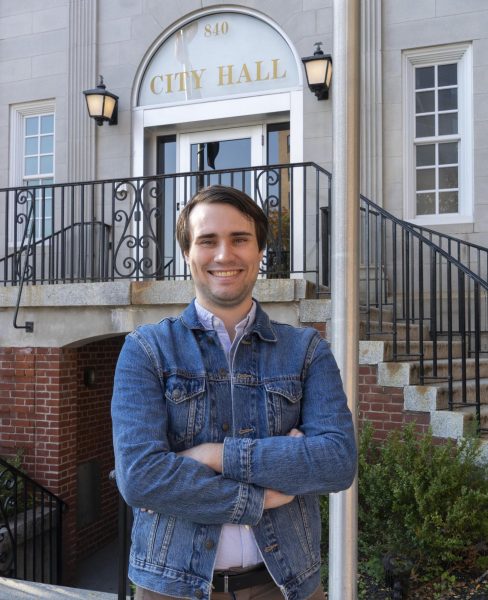
On Monday, April 27, Dwyer, along with over 10 community members at the Common Council meeting at City Hall, implored the city to consider an exclusive sale, saying the city charter gives wide discretion to sell blighted properties without an auction and negotiate it for any amount.
“You can decide what happens on that block,” Dwyer said during public comment. “The prices are depressed because of the condition of that building. You can demand that the developer that comes in does something really good for affordable housing. And I have a plan that works for small cities.”
According to property assessment records, the City of Peekskill acquired 946 2nd St. following an in rem tax foreclosure proceeding in 2012. Another property owner later purchased it for about $11,000 in 2014, before it later returned to Peekskill.
Dwyer told the Peekskill Herald that her vision includes demolishing the vacant building and restoring it with a slightly raised roof, using resilient natural materials, having stilts instead of a basement, and having a tenant in a unit on the second floor while she lives on the first floor.

City Attorney Eric Gordon advised the public that when Dwyer’s offer was made, the city was “obligated” to reach out to other people who may have been interested in the property. An unspecified number of people gave interest in the property and were given an opportunity to evaluate the property.
“Ms. Dwyer has asked for additional time to reassess the property and give her offer, which [I] think the city is willing to give the time that she’s looking for now,” Gordon said. “But the obligation is to get the highest and best value. And the city can’t actually take a lesser offer because they think the citizen who is seeking the property is better equipped for that property.”
As of this writing, Gordon and City Manager Matthew Alexander did not respond to an email request for comment. A request for comment was also left with Director of Planning Carol Samol, who is out of the office until May 4.

On April 22, an email Gordon sent to Dwyer said the city currently had another offer for the property and wanted to provide her with an opportunity to make an offer to purchase the property.
According to another email exchange between Gordon and Dwyer, on April 15 a water and sewer maintenance foreman met with a potential buyer of 946 2nd St. to determine where the sanitary sewer leaves the property. The water was turned on temporarily to conduct a dye test, and these results were shared with Dwyer on April 29.
Hopeful Developers Face Big Challenges in Property
Those interested in developing 946 2nd St. would face big challenges not just with the building’s deteriorating conditions but with its limited space to stage a construction.
The property nestled by the corner of S. Division St. and 2nd Street sits on a narrow hill without street access, bordered by a sidewalk students frequently traverse on their way to and back from Peekskill High School.

Standing outside the property on Tuesday, April 28, Dwyer told the Herald she would navigate that hurdle by installing prefabricated panels with large cranes for a solid shell in two or three days. Prefab, foundation, and demolition could be done in three to six months, she said.
For Dwyer, it would be the first time developing a building by herself. Growing up she watched her father, a contractor, build houses from scratch, do electrical subcontracting on various projects, and read over blueprints and submit bids for commercial projects like hotels on beaches and malls.
“My fear of foreclosure is what’s motivating me to do a two-family with an affordable unit,” Dwyer said. “Because I want my tenant to be someone who was comfortable there for a very, very long time and just paying the rent and having discretionary income to enjoy their life, so they don’t have to be stressed out that they’re paying the landlord constantly with all of their work.”
Dwyer said she hired an architect known to Peekskill, whose name she did not disclose, who she said would guide contractors and a manufacturing team and advocate for her in City Hall for permits and variances.
The vision for the property includes construction with natural products such as straw and wood, described by Dwyer as materials that last a long time, have a small environmental impact, and are more climate resilient. Instead of a basement, there would be stilts and pylons to allow the land to recover and allow more space for water to naturally flow, Dwyer said.

Dwyer acknowledged it was not an easy property to plan due to all of the unknowns. She said her inspectors were prohibited from entering the premises due to the dangerous conditions.
“If it has $150,000 worth of careful demolition because of the mold, lead, and asbestos, I have to add that into the budget and the future value of the property,” Dwyer said. “Because it’s going to play a big part in the affordability. All those unknowns could break my budget. Right now, I’m assuming that there’s a modest amount of mold, asbestos and lead, but if it’s out of control, I have to put in a bid that allows for the budget to work.”
Dwyer learned what the floorplans of the building looked like by obtaining city records of blueprints drawn up by a company who purchased the building in 2014 and sought to renovate the building. Those plans did not ever come to fruition. Prior to Dwyer expressing interest in the building, city officials said that within the past 10 years, there were a few people with inquiries into the property.
“I was told people were asked to bid before, and they declined,” Dwyer said. “And those who saw the house and made an initial offer, they withdrew as soon as they saw what needed to be done, which is why [Director of Planning Carol Samol] wanted me to make sure that I was serious because they were tired of going through the cycle of people being interested and then withdrawing for 10 years.”

Dwyer, a member of the non-profit civic group Architecture 2030, said she believed creating housing at the property was an opportunity to model “truly affordable urban housing.” She said the civic group talked about having a national organization watch her build to see if her approach would end up being affordable to then model it for East Coast cities.
“This is a science experiment for me,” Dwyer said. “I think it’s kind of a science experiment and an economy experiment to see if we can really build it and have it be affordable, and then I’ll have affordable housing for myself too.”
Supporters Engage in Conversation with City Officials
At the Monday, April 27 Common Council meeting, community members lined up to speak in support of Dwyer’s vision, including members of the Peekskill chapter of the National Association for the Advancement of Colored People.
Supporters of Dwyer criticized the choice to prioritize fair markets over what one resident described as an opportunity to envision Peekskill’s future.
Bethany Larson, a neighbor of Dwyer, said when she first met Dwyer she was leaving town to learn about turning straw hay bales into structures for houses and that she hasn’t stopped learning since then.

“Tanya’s ideas for 946 2nd St. are very well-researched,” Larson said. “They are credible, original plans that have been exciting to watch her create. She has spent countless hours reviewing city code, architectural drawings and budgets. These were her ideas, her plans, her vision for the revitalization of a small, forgotten and neglected piece of land that no one has cared about for as long as I have lived here, which is since 2012.”
City of Peekskill Mayor Vivian McKenzie pushed back against a few speakers’ assertion indicating that Dwyer’s request to purchase the building was denied by city officials because she was a Black woman.
“It’s not about racism,” McKenzie said. “It’s about how we sell this piece of property to make sure that we’re addressing it in the proper manner so that somebody doesn’t come back and say they gave [Ms.] Dwyer this piece of property and they didn’t get the full market for it, and so the citizens didn’t get what they deserve for it.”

Addressing Dwyer, she said, “I get what you’re trying to do. I appreciate what you’re trying to do. I think the whole council appreciates [it]. Affordable housing is what we want, and a project like that would be great. But we have to follow the process and procedure and that’s what this boils down to.”