


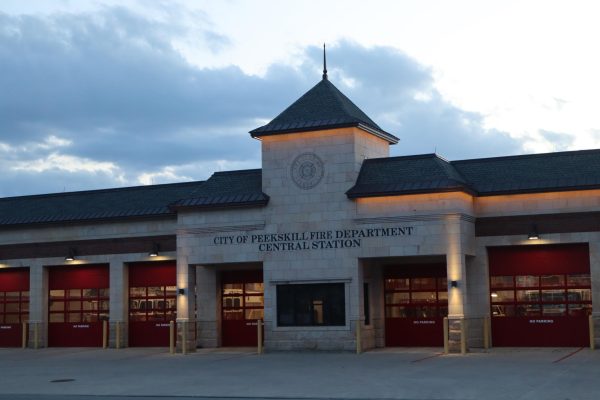
Despite transfer tax revenue adequately covering the cost of the annual debt service for the City of Peekskill firehouse, the debt service bucket, currently at $6.1 million, is restricted from being used on anything else, due to a local law passed in 2010.
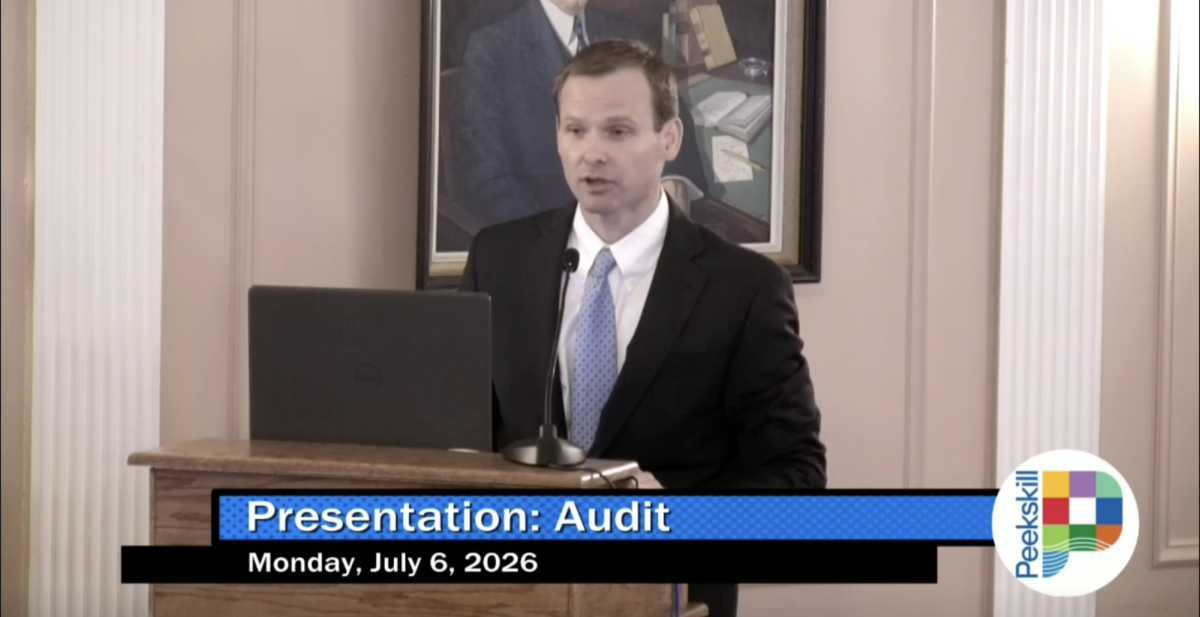
That was among the reports coming out of the 2025 audit presented to the Peekskill Common Council on Monday, July 6, by independent auditor Jeffrey Shaver, a partner at PKF O’Connor Davies.
“The good news is the transfer tax is more than covering the cost of the debt service for the firehouse,” Shaver said. “The bad news is the restricted fund balance keeps on growing because you’re not spending all of it.”
Shaver reported the city exceeded its budget plan by about $600,000 (about one percent of the $56.27 million budget). Revenues were $3.3 million less than forecast, and expenditures were $2.6 million less than the final budget.
The approximately $600,000 variance, in combination with a planned $980,000 use of the fund balance, which serves as a financial cushion
and for emergency savings, decreased the overall fund balance by $1.57 million for a total reserve of $16.4 million.
Fund balance greater than expected
The money in the bucket for debt service to the firehouse is continuing to climb, up half a million from the $5.6 million, as reported by Shaver in the 2024 audit financial statement presentation on Jan. 5.
According to the 2025 budget, $971,850 was allocated from the restricted funds reserved for the firehouse to pay the debt service. The city wrote in its budget that the reserve fund was accruing revenue sufficient to meet the annual debt service as a result of a strong real estate market in the city and the city’s real estate transfer tax, created to pay off the Central Fire House debt.
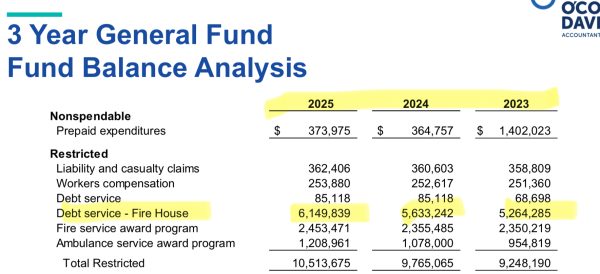
The fund balance was projected to be about $5.1 million by the end of 2025 but was instead $6.1 million, as reported by Shaver on July 6.
“The local law is written in such a way where you really can’t use those funds for anything else at this point in time,” Shaver told the council.
On Dec. 1, 2010, the Peekskill Common Council enacted a law that established a code providing that one percent of real property transfer tax monies collected go into the fire house building fund.
Then-Mayor Mary Foster was quoted weeks later in Patch saying, “We were in a situation where we needed to either rehabilitate all six of our firehouses and bring them up to code, or construct a new central fire house. And we found that the price differential between $14 million for rehabilitation and $15 million for new construction was not that different. So, after public hearings and some consideration, we decided that we should de-commission the old firehouses and get the properties back on the tax roll.”
While Shaver said the local law limits the way the city can use the funds, he previously said during the 2024 audit financial presentation that he spoke to Comptroller Toni Tracy about using the excess money for repairs and maintenance at the firehouse building, in addition to using it for debt service.
City Manager Matthew Alexander said at the July 6 meeting that city staff believe that the way the law was written actually allows for the fund to be used for other things. He said the city is expecting to come back with a potential solution in the budget to use funds in relation to new firefighters hired through a Federal Emergency Management Agency (FEMA) grant.
“We also believe that we have eight or nine years out for the future already in the bank,” Alexander said of the debt service. “So we will look for staff to be proposing something that might say this much can be used for the fire department, but in an expanded use. And we’ll talk to our accounting firm and our legal advice about what the steps would be for that.”
City Manager Alexander and Comptroller Tracy did not respond to a request for comment for how much debt is left over for the firehouse.
There is an overall total of $10.5 million in restricted funds, according to the three-year general fund balance analysis from Shaver, which, in addition to the fire house debt, includes liability and casualty claims, workers’ compensation, a fire service award program, and an ambulance service award program.
For other committed funds, Shaver said the city would need to take additional action in order to release them, including $300,000 for state retirement system expenditures and about $223,000 for tax stabilization.
Real property taxes and cannabis sales tax fall short
The amount of annual revenue the city expected to collect was $54.5 million, but it ended up at $51.8 million, about $3.3 million less than anticipated according to Shaver.
Federal aid and charges for services saw positive variances, while all other categories saw negative variances, including real property taxes, other tax items, non-property taxes, departmental income, use of money and property, licenses and permits, fines and forfeitures, sale of property and compensation for loss, state aid and miscellaneous.
Real property taxes collected were $664,507 less than anticipated; departmental income fell short by $635,175; licenses and permits collected were $200,000 less than the budget. For sales tax, Shaver said there was a negative variance of about $320,000, including cannabis sales tax which had a shortfall of about $400,000.
State aid funds were under budget by about $458,000. Shaver said most of that was due to under collection of Consolidated Local Street and Highway Improvement Program (CHIPS) revenue, adding that if the city doesn’t spend the money, it doesn’t get the money back.
While the city had a shortfall on its revenue, it had savings with expenditures, spending $2.6 million less than anticipated.
Public safety had a positive variance of $550,532 with the police department underspending by about $200,000 and the fire department underspending by about $300,000 according to Shaver; Transportation had a positive variance of about $542,000; and health insurance a positive variance of $1,575.
The general fund is $16,413,590. For ongoing capital projects, there is a fund balance of $453,984; for the water fund, a balance of $7.94 million; Section 8 has a fund a balance of $618,047; the community development fund has a balance of $1.8 million; non-major funds total $4.6 million.
The amount of outstanding debt is $27 million, with most of that due to be paid off within the next decade, Shaver said. In addition, the city also has $11.5 million of bond anticipation notes outstanding with interest at 3.75 percent.
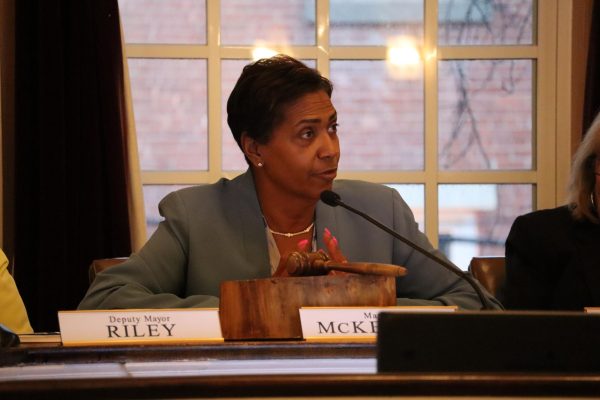
City of Peekskill Mayor Vivian McKenzie thanked Shaver for the professional report and reflected on the figures with the council.
“We’re in the middle of the year, so it’s good to get these numbers,” McKenzie said. “I want to say thank you to [city] staff for keeping their numbers in check and expenditures low. We just need to figure out how we increase those revenues so that we can get back on target. But staff is doing a great job at sticking to their budget and being under budget, and we truly appreciate that.”