


Do the benefits of a “community-owned” solar project built on top of a body of water used for residents’ drinking water outweigh potential risks? That was the question that informed a public hearing at the City of Peekskill Planning Commission on Tuesday, May 12.
The Ecological Citizens Project (ECP) and Working Power (WP) seek to deploy a floating solar array with a 1.68 megawatt system on the larger side of the Camp Field Reservoir at 1000 Lindberg Place, which is owned by the City of Peekskill. The project will be “community-owned,” meaning that the nonprofit ECP will own half of the project, with all of the revenue generated going back to the City of Peekskill, according to ECP co-director Jason Angell. The May 12 public hearing was held for final site plan approval.
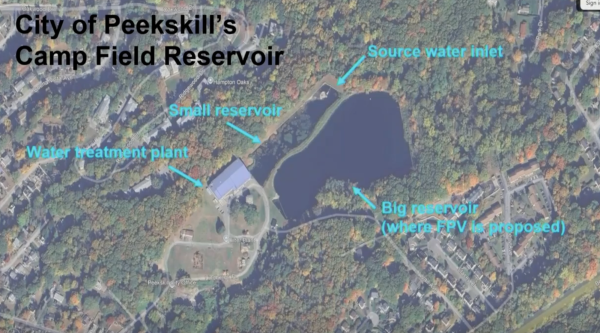
The applicants say the goal of the proposed solar program is to maximize economic benefits to the City of Peekskill and ensure that the project is built in a way that protects human and environmental health.
Angell, co-director of ECP, said the nonprofit project would bring a $2.8 million economic benefit to Peekskill over the project’s 25-year lifetime.
That valuation is based on lease payments to the city of $645,000 and $1.1 million in electricity bill savings, as well as $1.2 million devoted to the creation of a food sovereignty fund for local food access efforts, such as the Peekskill Regeneration Farm.
“We’re living in a time when electricity bill rates continue to skyrocket,” Angell said. “And we’re living in a time where food access is low, and food [prices] continue to skyrocket. And we’re living in a time where we know we need to meet the challenge of climate change. We think this approach can help tackle a number of those problems at the same time.”

Not all residents are on board. Of 10 speakers at a public hearing, the majority shared opposition. Of 15 letters sent to the Planning Board, the majority expressed opposition, according to Chair Jeffrey Stern. In addition, an online petition against the project created by resident Peter Korcz has seen over 272 signees as of this writing.
“Drinking water is a sacred resource and must be protected at all costs,” Korcz said at the hearing. “The panels and the floating platforms contain several substances like microplastics, chemical coatings that may potentially leach into our drinking water over time. Our water treatment plant is not equipped to remove all of them.”
Korcz said that while the $2.8 million “benefit” to Peekskill sounds like a big number, spread across 25 years it is about $112,000 a year, and spread across 25,000 residents it is about $4.50 per year per person. He added the drinking water is also partially used by about 2,200 residents of the Village of Buchanan.
“I’m not opposed to solar panels or renewable energy,” Korcz said. “In fact, our house has 36 solar panels on the roof. We have geothermal heating and cooling, and we drive two electric cars. So I’m all for it, just don’t install it on top of our drinking water.”

Others against the project shared similar concerns about contamination, the long-term effect on drinking water, and leasing service water to a private company. They also questioned why the solar could not be placed elsewhere, such as on the Hudson River or over parking garages.
Resident MaryAnn McCarra-Fitzpatrick echoed Korcz’s concerns.
“Placing solar panels over the water we drink, cook with, and bathe in is not a scenario where the benefits outweigh risks,” she said. “Better they should be placed in such a manner that there is no possibility they will contaminate either our water or our soil with clear protocols in place for their safe recycling. The outcome of this decision will not affect those in Philadelphia or Garrison [where WP and ECP are respectively based]. It will affect the residents of Peekskill. Any negative effects will be borne by our residents.”
A few residents voiced support for the project via public comment and letters to the Planning Commission, including Marcus Ryan, who contested the claim that panels would contaminate drinking water.
“The floats are food grade HDPE [High–Density Polyethlyne],” Ryan said. “That’s the same plastic already in our municipal water distribution pipes, 50- to 100-year life, zero PFAs [Perfluoroalkoxy]. The panels contain .05 percent lead, used only in the internal solder, sealed inside glass. Every safety data sheet for every material in contact with the water is already on the Planning Commission website. Our water department already tests for 125 contaminants, PFAs included. And then the developer is paying for additional testing on top of that.”
(According to the United States Environmental Protection Agency, PFAs are widely used, long-lasting chemicals, components, found in many different consumer, commercial, and industrial products, which break down very slowly over time. According to AcmePlastics.com, food grade that is industrial-grade, FDA, NSF, and USDA-approved food-quality HDPE sheets are safe, easy to clean and resistant to corrosion.)
Ryan added that most “critically,” the lease agreement requires the removal of the entire system at the developer’s own cost if testing ever links the contamination to the array. The lease also includes a stop gate so the city can isolate the larger reservoir from the smaller one in event of an issue.
“I want to talk a little bit, though, about the risks that we’re not talking about. The risks of not doing the project,” Ryan said, adding the county will be experiencing a “subsistence shock” from federal commodity program cuts and energy price spikes. “With this project that is offering meaningful energy sovereignty, meaningful food sovereignty, where the revenue is going into funds that are helping this community grow its own food, hardening itself against these shocks, it seems absolutely necessary that we do this.”
Prior to the hearing, applicants gave an extensive presentation on the project, including ECP co-directors Jason Angell and Jocelyn Apicello; WP co-executive director Ian Fischer; managing director Stetson Tchividjian of D3 Energy, the contractor for the project; and senior civil engineer Mufuta Tshimanga of LaBella, a national engineering and environmental consulting firm.
In 2023, the City of Peekskill issued a request for proposals to develop community-owned solar on municipally-owned properties. ECP and WP applied and were awarded the project in April 2024. Angell said the property that rose to the top of the city’s list for development of floating solar was the Camp Field Reservoir.
Since that time, Angell said, applicants have given six public presentations to the Common Council at public meetings, presented several times to local organizations, held regular meetings three times a month with the city manager and city sustainability team to collect feedback and adapt the model, and made four site visits.
D3 Energy, the contractor for the project, has built over 25 floating solar systems across the United States, according to Tchividjian. Most recently there is a 6 megawatt floating solar array project on Monroeville, Ohio’s drinking water reservoir; a 1.5 megawatt floating photovoltaics (FPV) project for a private water utility in Ohio; and a 600 kilowatts FPV project in Signal Hill, Utah.
There are nine floating solar projects that have been developed on drinking water reservoirs in the United States. Two sites were reached out to by the City of Peekskill water superintendent. Angell said they reported no negative impacts and were planning on adding FPV projects.
Apicello said the City of Peekskill’s source of drinking water comes from Wiccoppee watershed in Putnam Valley. It then flows through the Peekskill Hollowbrook and eventually gets pumped from a pump house in Cortlandt Manor to the Camp Field Reservoir. The pre-treated water is held in the reservoir and eventually passes through the water treatment plant.

The estimated construction of the solar array project is three to four months. In its lease, the city asked for the right to purchase the panels at the end of the 25-year life term.
The applicants previously worked with the city to hire Arcadis, a consulting firm and leading water quality expert, to take a look at the proposed project, meet with city officials, and issue a report in March 2025.

In that report, Arcadis said, “Based on our review, we do not see unacceptable negative water quality impacts as a likely outcome and believe that ongoing monitoring can be used to preemptively identify any impacts that could occur.”
The Planning Commission voted to declare itself the lead agency to coordinate environmental review across multiple agencies, including the Common Council, Department of Health, Department of Environmental Conservation, Westchester County, and others. No further action was taken.
Planning Commission Chair Jeffrey Stern emphasized that although the public hearing was for final site plan approval, it was the only the beginning of the process, not the end of the process, and that the commission could wind up turning it down. The public hearing was left open for residents to continue to comment.
Commission member Victor Drapala said it was a “very risky project for the city,” while commission member Gregory Schondelmeier said he didn’t like Arcadis’ saying it did not see “unacceptable negative water quality impacts.” He questioned what qualifies as acceptable negative water quality impacts.
“We’ve never known in the history of humankind about health risks in real time, and so they appear in the future,” Schondelmeier said. “And this could very well happen to us here in Peekskill. And if Working Power didn’t exist, and ECP didn’t exist, and nobody picked up that bond, it’d be on us. And sometimes it feels like the City of Peekskill doesn’t have two pennies to rub together, and we are not going to be in a position to remove a solar array if it’s negatively impacting us. I’m hard-pressed to feel the benefits outweigh the risks on this one.”
In closing, Angell said if city residents discussed the project, considered the research on materials being used, and said they didn’t want the project to be built, then applicants would not push it onto Peekskill.

“We’re trying to build a system that is going to deliver and leave economic benefit,” Angell said. “And this is being built in a way that addresses all of the concerns raised. You can never address everything. There’s an emergency management plan. We will continue to give you answers. This is a project meant to benefit the community and it is a city decision, and it should be. And people should weigh in, and they should give their concern as they’ve done tonight.
“And if it’s proven that …this is the concerns people have and nobody wants this project, these economic benefits, this model, won’t be here in Peekskill. And that is how it goes in a democracy.”