

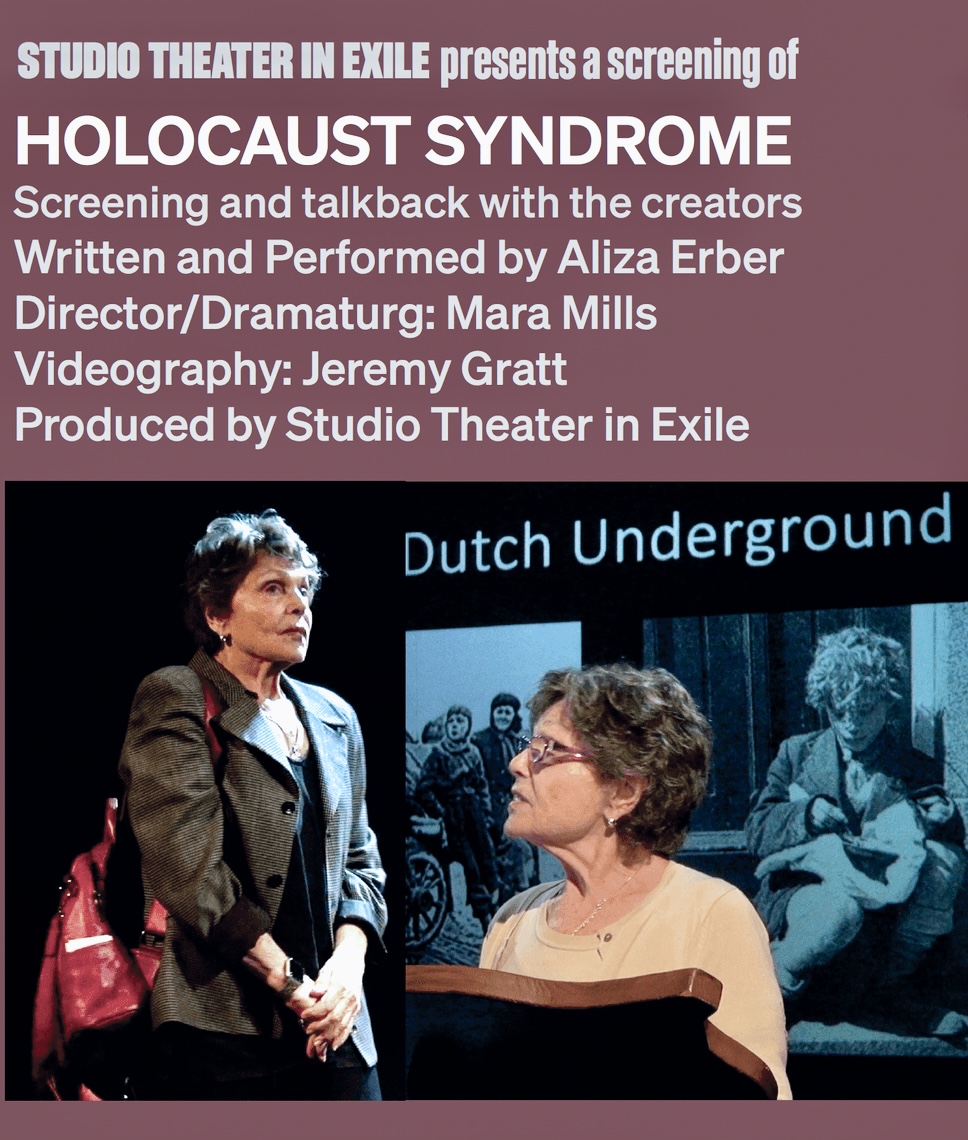

Cinema liberates, transforms and documents. It is capable of holding pain, fear, but above all, hope for a better future. On April 25 and 26, a story built from personal memory and the legacy of trauma will be screened in Peekskill. The one-woman play Holocaust Syndrome will have two limited showings at Studio Theater in Exile, inside Hudson Valley MOCA [Museum of Contemporary Art]. At the conclusion of each screening, there will be a question-and-answer session with playwright Aliza Levy-Erber and director Mara Mills.
The work examines the impact of intergenerational trauma through the relationship between mother and daughter. The mother, a Holocaust survivor, is unable to offer emotional care after the devastation experienced. The daughter grows up in that void. The narrative is not limited to an individual experience; it also brings together the testimony of children and grandchildren of survivors, expanding the focus toward the consequences that persist beyond the generation that lived through the war.
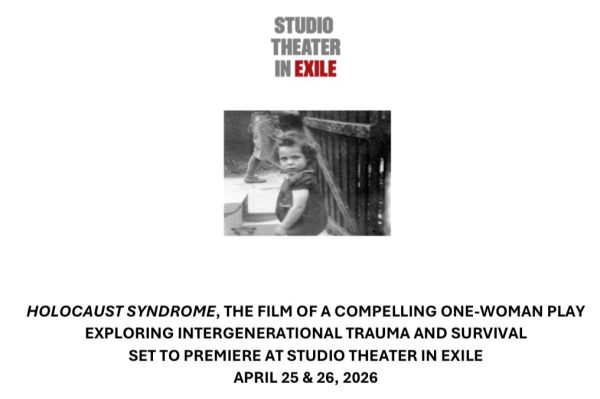
The story follows Emmi, a child survivor of the Holocaust. Her life after the war appears stable, but over time it begins to fragment. The work advances from that rupture. Emmi constantly returns to the past in an attempt to separate her own memories from those inherited. That search is not linear. It is marked by internal tensions, family silences and unresolved questions.
In the screening, which will begin at 3 p.m., the journey to Terezín Concentration Camp marks a turning point. There, Emmi discovers details about the life of her father, Richard Levy, that, far from offering peace, give way to new layers of conflict. The work also incorporates the therapeutic process of the protagonist as part of her attempt to build an identity of her own, differentiated from inherited trauma.
The text is based on the life of Aliza Levy-Erber, born in Holland during World War II. At two months of age, she is taken into hiding. She spends nearly two years in an underground bunker in the Dutch woods, surviving on a diet of roots, grasses and tulip bulbs. After the war, she reunites with her mother and learns that her father was murdered in Auschwitz, along with other members of her family in different places of extermination.
After the war, Levy-Erber lived in Israel for a time and later in Palestine following her mother’s remarriage. In 1959, she emigrated to the United States. Her professional trajectory includes medicine, university teaching, rabbinic pastoral work and artistic creation. In March 2024, she received the Forbes “Torch of Freedom” Award and, in May of the same year, the Julian Y. Bernstein Distinguished Service Award from the Westchester Jewish Council. In 2019, she also received a lifetime achievement recognition from The City University of New York for her educational work on the Holocaust.
The direction of the film is by Mara Mills, who has more than 35 years of work in theater in the New York metropolitan area, the state and Connecticut. Her focus is centered on the development of original works. She has worked in arts education from preschool to graduate level and has directed projects linked to historical memory, including the theme of the Holocaust. The creation of Holocaust Syndrome was described as a prolonged process shaped by emotional complexity. Production and videography are by Jeremy Gratt, co-founder of Studio Theater in Exile.
Tickets for the screening will cost $20 for general admission and $15 for students and Hudson Valley MOCA members. Organizers recommend reserving in advance through Studio Theater in Exile. For more information, visit the organization’s website.