


It’s something they’ll never get over.
For the co-workers of slain social worker Maria Coto, her death has devastated them and is a jarring reminder of the risks they face everyday as they go about their jobs.
Coto was murdered by Hasseem Jenkins when she knocked on the door of an apartment at 900 South St. in May 2024. Jenkins was found guilty by a jury on Nov. 5 of second-degree murder while committing a felony burglary, first-degree manslaughter, first-degree robbery, first-degree burglary and third-degree possession of a weapon. He faces sentencing from Judge George Fufidio in White Plains on Dec. 11.
Maria’s co-workers in the Peekskill office of the county Department of Social Services wrote letters to Judge Fufidio describing how her death has affected them. “It’s hard to put into words the impact of her death,” said Elizabeth Vicchio. “It’s a scary thought; you wake up, go about your business, do your job and lose your life in such a horrific manner. It’s a hard pill to swallow.”
“Her murder made every one of us confront the fragility of our own safety,” wrote Linda Argiento, Maria’s supervisor for the nearly two decades that Coto worked in the Peekskill office of DSS in the child welfare division.
“Staff who have spent years performing home visits without fear now hesitate. Some have nightmares, Some have asked for additional security measures. All of us carry a heightened sense of vulnerability that did not exist before.”
“The weight of knowing that someone we care about – someone strong, capable, and experienced – lost her life simply by doing her job has changed the way we move through the world,” added Argiento.
Many of Maria’s co-workers attended the three-week long trial at the Westchester County Courthouse in White Plains. “It was a hardship to sit there and listen to the testimony and watch the videos and then come back to the office,” said Jefferson Romero. “It plays in your mind and it’s hard to switch off.”
Not everyone had the fortitude to attend the trial. “It was difficult to be in court. I couldn’t go when the medical examiner testified but I will go for the sentencing,” said Dayanara Lizarra, Maria’s co-worker who had lunch with her the day she died. “She was more than a colleague, she was a friend. I spoke with her everyday and I miss her, especially on holidays, like Halloween or her birthday. Maria was a big celebration person,” recalled Lizarra.
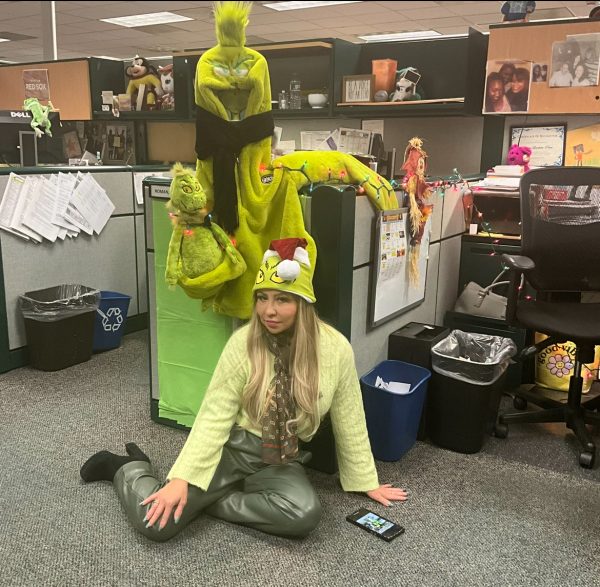
Nearly 80 percent of the staff at the office has turned over according to Lizarra. “There are five or six of us who were close to her and we talk about her to the new people but they can’t capture the special person she was,” said Lizarra.
Manager Argiento confirms that the Peekskill unit lost a lot of people because of what happened to Maria. “They took other jobs,” she said. She and Romero said they had a certain amount of guilt sitting in the courtroom listening to testimony about Maria’s death. Coto spoke to both of them of her desire to retire before she had the total amount of years she needed to collect a full pension. “We told her, ‘you can’t leave, the people need you.’ So she decided to ask for a transfer out of child welfare and move to the housing unit. She was in the housing unit for less than two months. As I sat in court, I kept thinking of those conversations,” said Argiento.
When the prosecution played the video of Jenkins after his arrest saying over and over to the officers in the holding cell, ‘what’d I do, officer, what’d I do officer?’ I had to manage myself to not jump up and say ‘you murdered her,’” said Argiento.
Argiento, who manages between 35 and 40 people in the Peekskill unit, said she felt the burden and responsibility to tell her staff exactly what was happening with Maria. “I could feel their fear, their ‘am I next?” when they learned about Maria. I had to establish trust with them, that I was telling them everything I knew. I decided I was going to say everything I knew from day one.”
When Maria’s family decided to take her off life support on June 19, Argiento felt Maria orchestrated that decision because it was Juneteenth and the office was closed. “People were hearing the news in the comfort of their own homes where they were able to process it. It was as if Maria was saying ‘mourn me the right way,’” said Argiento.
Elizabeth Akinleye, who has worked in the Peekskill office for 35 years, doesn’t drive by the building on the corner of South Street and Nelson Avenue where Maria was attacked. “I love what I do and despite people like him (Jenkins) we’re not going to give up what we do.” She can’t help remembering Maria everyday when she opens the closet of her granddaughter who Maria gave so many clothes to.
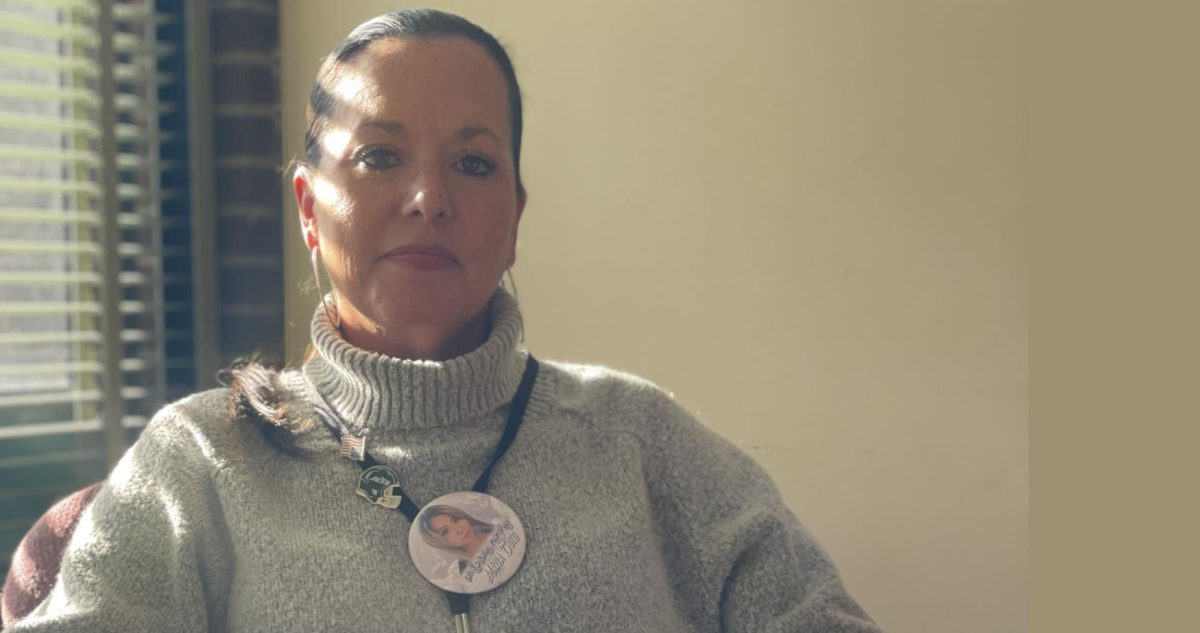
“It was challenging to listen to evidence presented during the trial,” said Elizabeth Vicchio who has worked in Child Welfare for 25 years and with Maria for 20 years. “She worked with the community, she was not intimidating, and was a very helpful, empathic person. I wish there wasn’t a trial. I would love to remember her the way we knew her. It was disturbing to listen to the defense attorney hardly refer to her by name and when he did, he mispronounced it. He never once said it was unfortunate that she died. It was so cold. We couldn’t believe that this was our reality,” said Vicchio, who wears a button with a picture of Maria attached to her work lanyard.
The half dozen co-workers interviewed for this article said they have a heightened vigilance for their safety and if they are managers not going into the field, they have a sense of anxiety for the safety of the caseworkers they supervise.

As a result of Maria’s death Westchester County made a safety app for their phones available. It can be activated when they go on a call and if it isn’t disabled after a certain period of time, police are alerted. But on many of the calls they go on in areas that are remote such as Katonah or South Salem or even Cortlandt, the cell service isn’t reliable.
Westchester County also made security escorts available for social workers going on calls, but the escorts aren’t there to protect the workers, they are there to alert authorities if help is needed. And there aren’t enough members of the security details to go with every social worker on every call. Elizabeth Akinleye said a new bond and allegiance to one another to keep each other safe has been created since Maria’s death. “We have a fear that who she was will simmer down or disappear. We’re not going to let that happen,” said Jefferson Romero.
As a way of honoring Maria’s memory, the Civil Service Employees Association union that Coto belonged to is naming their fourth annual toy drive after her. Every child that gets a toy will also get a stuffed animal dog with a pink collar. Maria loved her dog and her favorite color was pink. It is a fitting tribute to one who gave so much to those she worked for, including her life.